Featured Post

Your Life Is a Poem

In the new episode of ON BEING, " Your Life Is a Poem ," poet Naomi Shihab Nye talks about growing up in Ferguson, Missouri and o...

Tuesday, April 5, 2016

Prompt: In your next letter,

A Lady Writing by Johannes Vermeer, 1665
The Latin �epistula,� for �letter," led to epistolary poems, which are poems that read as letters.

They can be to an internal or external audience, to a named or an unnamed recipient or to the world at large, intimate or not, to abstract concepts or real people. The epistles can use any form or free verse. It's a type of poem with much freedom.

Elizabeth Bishop�s �Letter to N.Y.," uses rhyming quatrains and begins:
In your next letter I wish you�d say
where you are going and what you are doing;
how are the plays, and after the plays
what other pleasures you�re pursuing:

Bishop's poem came back to me when I read "In your next letter," from Cause for Concern (Able Muse Press, 2015) by Carrie Shipers when it was featured recently on The Writer's Almanac.

Shipers poem uses Bishop's opening for its title and then goes on to say:
                                             please describe
the weather in great detail. If possible,
enclose a fist of snow or mud,

everything you know about the soil,
how tomato leaves rub green against
your skin and make you itch, how slow

the corn is growing on the hill.
Thank you for the photographs
of where the chicken coop once stood,

clouds that did not become tornadoes.

This month we'll be writing epistles, which date back to verse letters of the Roman Empire, and was refined and popularized by Horace and Ovid.

You may want to use the conventions of a letter, as Langston Hughes does in his �Letter," which begins:
Dear Mama
Time I pay rent and get my food
and laundry I don�t have much left
but here is five dollars for you.

You can certainly be creative in your use or abuse of letter writing forms and conventions.

Submissions to this prompt are due: Sunday, May 1, 2016

More on Carrie Shipers at www.carrieshipers.com


Friday, April 1, 2016

April Is


In "The Waste Land," T.S. Eliot wrote:
April is the cruellest month, breeding
Lilacs out of the dead land, mixing
Memory and desire, stirring
Dull roots with spring rain.
But I think you should think of April as National Humor Month as well as being National Poetry Month.

Why not save get your dull roots out of the spring pain and rain and save time by combining both of those celebrations by reading (or listening) to some humorous poetry. You might want to start with some  Billy Collins.


Wednesday, March 30, 2016

Simply Emily


Emily's poems look so simple, but are often so hard to understand  It is so interesting that the relative simplicity of her verse forms actually make it more difficult to pull meaning from our reading of her.

Emily Dickinson's poems often have images and metaphors taken from all around her, especially from nature, but they are just as often psychological landscapes.

Did she want to challenge her readers? Of course, the first published book of her poetry appeared in 1890, four years after her death. I wrote earlier this month about Sylvia Plath's collection, Ariel. I don't think there are many critics connecting Emily to Sylvia, but I see one connection. As with Plath's book, Emily's small poetry collection was also heavily edited by men. They were very selective and removed her unique syntax, spelling, and punctuation.

It took much longer for Emily's true verse to appear than it did for Plath's intended book. The complete, restored edition of Emily's poetry did not appear until 1998 - more than 100 years after the original publication.

I was never fond of allegory, but Em enjoyed using it. Was she writing for me? Was she writing for any of us? I think she was. As often as I hear poets say that they write "for themselves,"  they all are happy to have their poems published. 

What is the writing lesson of Emily's poems?  perhaps, it is similar to this passage from Mr. Whitman.
�The secret of it all, is to write in the gush, the throb, the flood, of the moment � to put things down without deliberation � without worrying about their style � without waiting for a fit time or place. I always worked that way. I took the first scrap of paper, the first doorstep, the first desk, and wrote � wrote, wrote�By writing at the instant the very heartbeat of life is caught.�  Walt Whitman

I wonder if Em's odd use of dashes instead of periods, commas, and the other typical punctuation. marks.  She also liked to capitalize words - not just words at the beginning of a line.  Why? Not totally clear. .

I have read that the use of dashes and of capital letters to emphasize and personify common nouns was something she may have found in the grammar text (Wells' Grammar of the English Language) that she used at Mount Holyoke Female Seminary.

I like those dashes. Fast and simple punctuation. Reminds me of the dashes you find in haiku. A  nice clear indicator to the reader to break, and sometimes a nice bridge to a new idea.

As a young reader, I imagined prim and proper Miss Dickinson as a good, religious girl. I discovered later she had a a lot of skepticism about traditional religion. She would fit nicely into that growing number of  Americans who say they are not "religious" but are "spiritual. She said that "Some keep the Sabbath going to Church" but she was quite content Sundays at home in her garden where "the sermon is never long.�

At Mount Holyoke, they organized students into three categories: "established Christians,� those who �expressed hope,� and those who were �without hope.� Guess which group Emily was in?  I bet she got picked last for softball too.

But, she had her books: Longfellow, Thoreau, Hawthorne, Emerson, George Eliot, and the Brownings.

She loved the Bront�s. She wrote �All overgrown by cunning moss" for the death of Charlotte Bront�, 

All overgrown by cunning moss,
All interspersed with weed,
The little cage of �Currer Bell�
In quiet �Haworth� laid.

This Bird � observing others
When frosts too sharp became
Retire to other latitudes �
Quietly did the same �

But differed in returning �
Since Yorkshire hills are green �
Yet not in all the nests I meet �
Can Nightingale be seen �

Emily requested that a poem by that other Emily -  Bront�  - be read at her own funeral. I hope the family granted her wish. I hope it wasn't "Remembrance."  Maybe it was "Ah! Why, Because the Dazzling Sun."
Ah! why, because the dazzling sun
Restored my earth to joy
Have you departed, every one,
And left a desert sky?


Sunday, March 27, 2016

Bill Murray: Poetry Editor


Bill Murray supports New York's Poets House and has been known to hang around with Billy Collins and others and read or post poems. In celebration of National Poetry Month, Oprah Magazine asked him if he would be interested in picking some poems for the magazine to print and to comment on them. He was and he did.


Galway Kinnell, Lucille Clifton, Thomas Lux and Naomi Shihab Nye are among the poets that Murray chose to include in the issue.

Some of his comments:

On Kinnell's "Oatmeal," about the poet sharing a meal with the late John Keats: "Alas, Kinnell, too, is now available for breakfast." (Kinnell passed away in 2014.)

Lux's odd romantic ode "I Love You Sweatheart" starts out:
A man risked his life to write the words.
A man hung upside down (an idiot friend
holding his legs?) with spray paint
to write the words on a girder fifty feet above
a highway.
The poem got this note: "This poem vibrates the insides of my ribs, where the meat is most tender."

Nye's poem "Famous" says:
I want to be famous in the way
a pulley is famous
or a buttonhole, not because it did
anything spectacular
but because it never forgot
what it could do.
Murray comments on it: "It's not the dream of being big. It's the dream of being real. That's what stands out to me."

www.nme.com/news/

Friday, March 25, 2016

National Poetry Month 20th Anniversary

April is National Poetry Month. Since 1996, we have a put more emphasis on things poetic for that month and it has become the largest literary celebration in the world. This year is the 20th anniversary celebration of poets and poetry.

I have been getting a copy of the official National Poetry Month poster and collecting them since the beginning. For 2016, artist Debbie Millman created one which features lines of poetry by some of our greatest poets. 

The Academy of American Poets distributes over 120,000 posters to classrooms, libraries, and bookstores throughout the United States and you can get one for free, while supplies last.


https://www.poets.org/national-poetry-month/
https://www.poets.org/national-poetry-month/form/poster-request-form

Friday, March 18, 2016

Plath's 'Ariel' at 50

Podkowinski-Szal uniesien-MNK.jpg

Ecstasy (1894), a painting by Wladyslaw Podkowinski, depicting a ride similar to that described in "Ariel"
www.culture.pl, Public Domain


Listening to a recent program from the Poetry Off the Shelf podcast, I am reminded that Ariel, Sylvia Plath's posthumous collection, is 50 years old.

Ariel was the second book of Sylvia Plath's poetry to be published, and was originally published in 1965, two years after her death by suicide.

Plath is credited with being a pioneer of the 20th-century style of writing called confessional poetry. Her poem "Daddy" is one of the best-known examples of this genre.

The poems in the 1965 edition of Ariel are filled with frightening psychic landscapes, and were very different from her first collection, Colossus.

In 1963, Plath's semi-autobiographic novel The Bell Jar was published under the pseudonym "Victoria Lucas" (and reissued in 1966 under her own name).

In the collection's title poem, a woman is riding her horse in the country at dawn. I recall reading the poem in a college class and the professor telling us that there were three Ariels to consider.

One was Sylvia Plath's own horse, which she loved to ride. Second, was that androgynous sprite from Shakespeare's The Tempest which I had read that same semester and quite loved. The third allusion, if she intended it, was to Jerusalem, which was also called Ariel in the Old Testament.

I don't know that I have even now completely understood her poetic "Ariel."

In the 1965 edition of Ariel, her husband, the poet Ted Hughes, had changed Plath's chosen selection and arrangement by dropping twelve poems and adding twelve others.

He also asked the poet Robert Lowell to write an introduction because Plath cited Lowell's book Life Studies as having had a profound influence over the poetry she was writing at the time.

Another influence was Anne Sexton who was similarly exploring some of the same dark and personal subjects that Plath was using in Ariel.

In 2004 a new edition of Ariel was published which for the first time restored the selection and arrangement of the poems as Plath had left them.

This edition has a foreword by her daughter Frieda Hughes.

Sample several of the poems:
Ariel
Fever 103�
Morning Song

More about Sylvia Plath.


Saturday, March 12, 2016

That Train in the Distance Carried Harry Potter

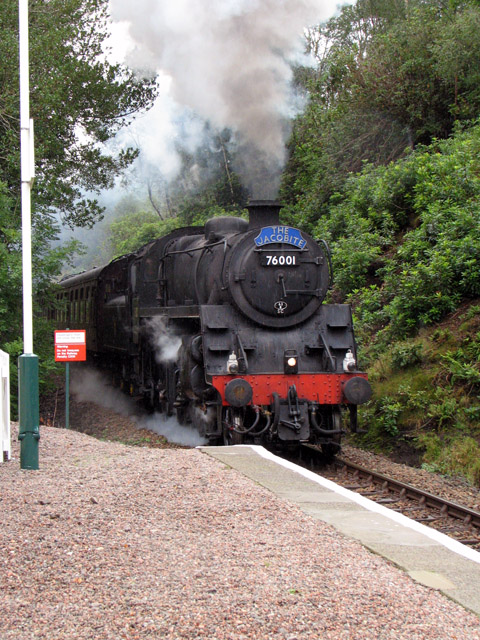
While searching online for some images of trains to use for this month's prompt, I came across a video of the Jacobite steam train.  It seemed familiar, though I have never been to Scotland where it runs.

The Jacobite is a steam locomotive-hauled tourist train service that operates over part of the West Highland Railway Line in Scotland. It has been operating under various names and with different operators every summer since 1984. It has played an important role in sustaining a scenic route.


The Jacobite runs a distance of 41 miles between Fort William and Mallaig.

The route is also the same shown in the Harry Potter films.

The company running the Jacobite service provided Warner Brothers with the train used as the Hogwarts Express in all of the movies and allowed them use of the Jacobite's route for filming.


Photo: Scottish Tourist Board