I love serendipity. I was looking at poems online looking for inspiration and came across one by Julie Kane titled "Maraschino Cherries." I have a soft and rather sweet spot for maraschino cherries. In my childhood, they were something I loved to pilfer from our refrigerator. As an adult, I still love them in a manhattan cocktail.
Julie's poem made me think of another maraschino cherry poem that I have always liked - "Refrigerator" by Thomas Lux.
I definitely identify with Kane's
Three little girls on the morning after,
out in the kitchen poking around
for cherries soaked in whiskey like a bomb
of grown-up secrets.
They were bolder than I was in my youth. Actually, I can't recall my parents making any cocktail with those cherries that I might have stolen with some booze. I think my mother used the cherries only on top of ice cream sundaes.
Like Thomas Lux, my childhood refrigerator contained
not a lot,
and what there is (a boiled potato
in a bag, a chicken carcass
under foil) looking dispirited,
drained, mugged. This is not
a place to go in hope or hunger.
It was dull vault. But there was one item that stood out:
heart red, sexual red, wet neon red,
shining red in their liquid, exotic,
aloof, slumming
in such company: a jar
of maraschino cherries. Three-quarters
full, fiery globes, like strippers
at a church social.
In rereading Lux's poem, I was surprised to find that he also can not recall seeing them used in a drink, or on ice cream. He doesn't even recall anyone even popping one in their mouth. They were something to be passed on like a family heirloom.
and, if I never ate one,
it was because I knew it might be missed
or because I knew it would not be replaced
and because you do not eat
that which rips your heart with joy.
Though I am very tempted to make our October writing prompt just maraschino cherries, that may be a bit limiting. So, we are expanding to any fruit in a poem that centers around one type. It might be nice if it is also sexy and exotic, or like a bomb of grown-up secrets or like strippers
at a church social.
Each of us has a unique part to play in the healing of the world. - Marianne Williamson
Readers of this blog and poetry contributors to Poets Online don't need to be told that poetry can contribute to healing. As readers and as writers of poetry, we can all think of instances when a poem helped us or someone we know to heal.
Healing can be taken literally, as in coping with diseases both physical and mental. And healing can be seen as that process that moves us through transformation and into growth from a bad place to a better one.
In the aftermath of the World Trade Center attacks on September 11, 2001, poetry sprang up everywhere. A New York Times article on October 1, 2001, documented the phenomenon: �In the weeks since the terrorist attacks, people have been consoling themselves�and one another�with poetry in an almost unprecedented way � Improvised memorials often conceived around poems sprang up all over the city, in store windows, at bus stops, in Washington Square Park, Brooklyn Heights, and elsewhere. ��
Some catastrophes are so large, they seem to overwhelm ordinary language. Immediately after the recent tsunami disaster in Southeast Asia, the Los Angeles Times reported the witnesses were literally dumbstruck. Words failed them. They had lost their voices.
In mainstream culture, there are subjects we do not talk about. They are taboo. For example, even though each of us is going to die, we don't talk about dying. Instead, we avoid it. Even physicians are reluctant to talk with terminally ill patients about the patient's experience...
Poetry gives us ways to talk about it. My job as a poetry therapist is to use poetry and voice to help people get access to the wisdom they already have but cannot experience because they cannot find the words in ordinary language.
I wouldn't recommend poetry as "alternative medicine" or a substitute for traditional medicine, but I would recommend it as a supplement to any treatments.
For our writing prompt this month, I am more interested in the figurative sense of healing, but there are certainly many examples of poets who have used the more literal sense of healing in their poems.
You may not be aware of "poetry therapy" which is defined by the National Association for Poetry Therapy as "the intentional use of the written and spoken word to facilitate healing, growth and transformation." Their membership includes mental health providers, medically trained physicians, nurses, educators, and artists, writers and others who use poems or the writing process as a healing practice.
I have always found that being out in nature feels like healing to me. This feeling is captured simply in "The Peace of Wild Things" by Wendell Berry. He says "When despair for the world grows in me" that he will "lie down where the wood drake / rests in his beauty on the water, and the great heron feeds."
What is it that we find there that feels like it can heal us? I think we envy at moments like that the wild things "who do not tax their lives with forethought of grief" and want to be in that freeing place, if only for a short time.
Poet Richard Hugo believed that we�ve written every poem we ever loved. He said that he was particularly proud of having written Yeats� poem Yeats� �Easter, 1916.�
The Dodge Poetry Festival blog has asked several poets "What great poem are you proud of having written?" One of my first professors of poetry, Alicia Ostriker, said she was "I�m pretty proud of having written Antony and Cleopatra and King Lear. Maria Mazziotti Gillan answered, "I am proud to have written 'somewhere i have never travelled, gladly beyond' by E.E. Cummings. I often recite it to myself when I�m driving or walking and I find it very comforting. I think it is one of the most beautiful love poems I have ever read."
He argues against the often heard idea that a writer should �write what you know.� Instead, he suggests an approach to poetry based on triggering subjects and words.
In one essay, he explains triggering subjects, using the example of towns, as points of entry into the realm of the imagination.
Again, opposing the write-what-you-know, he suggests that new poets might try to own an imagined, or barely-known, town, rather than trying to convey their actual hometown. That hometown, he feels, may be one in which �the imagination cannot free itself to seek the unknowns.� Then, the poet can focus on the play and music of the language.
At this point, the poet's private language, personal connections and certain words that have rich associations for the poet can move the poem forward.
�Your triggering subjects are those that ignite your need for words. When you are honest to your feel�ings, that triggering town chooses you. Your words used your way will generate your meanings. Your obsessions lead you to your vocabulary. Your way of writing locates, even creates, your inner life. The relation of you to your language gains power. The relation of you to the triggering subject weakens.�
Hugo's book is not about writing prompts, but it does offer a lot of advice. Here are some examples:
�Don�t write with a pen. Ink tends to give the impression the words shouldn�t be changed.
Write in a hard-covered notebook with green lined pages. Green is easy on the eyes. Blank white pages seems to challenge you to create the world before you start writing. It may be true that you, the modern poet, must make the world as you go, but why be reminded of it before you even have one word on the page?
Don�t erase. Cross out rapidly and violently, never with slow consideration if you can help it.
Read your poem aloud many times. If you don�t enjoy it every time, something may be wrong.
Never write a poem about anything that ought to have a poem written about it.
Maximum sentence length: seventeen words. Minimum: One.
Start, as some smarty once said, in the middle of things.
As with this month's writing prompt, the title is the trigger. In this case, the trigger is a place.
In the poem, we explore the place, both by seeing what the poet saw, and what no one can see with their eyes - such as the Indians who were once there.
I did a simple search and found that real church. You don't need the history to understand the poem, but the history does help you see why it triggered the poem.
Your assignment this month is first to tell us up front in your title what it was that triggered the poem. Second, your poem needs to begin rather literally with that triggering person, place or thing, but then it needs to move beyond that to things we would not know even if we encountered that trigger. It should be two stanzas.
Of course, that second stanza is what makes it your poem. It contains what it triggered in you that might not be triggered in any other poet.
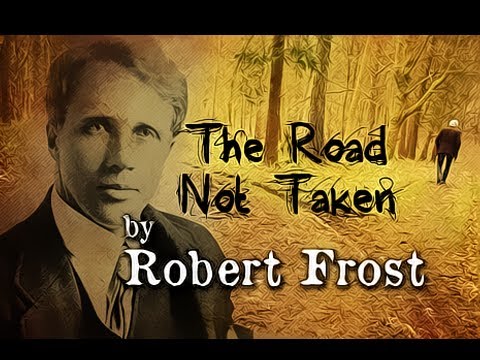
One poem that you can safely assume that an American student has encountered is Robert Frost's "The Road Not Taken." It is in many anthologies used in schools and has become a phrase used by people who may not even know the source. It's so much of a classic, that it's almost a clich�.
An article by Katherine Robinson on www.poetryfoundation.org goes into greater detail than your high school English teacher may have in discussing the poem.
Did you know that Robert Frost wrote �The Road Not Taken� as a joke for a friend? That friends was fellow poet Edward Thomas who took walks with Frost. Apparently, Thomas was quite indecisive about the path to take and sometimes expressed regrets later about the one not taken.
Frost wrote the poem in 1915 and told Thomas that after reading the poem at a college, he was surprised that the audience had been �taken pretty seriously � despite doing my best to make it obvious by my manner that I was fooling. � Mea culpa.�
From the poem's opening decision about choosing a road, to the conclusion that the choice has made all the difference, there is an odd and somewhat surprising word journey.
Two roads diverged in a yellow wood, And sorry I could not travel both And be one traveler, long I stood And looked down one as far as I could To where it bent in the undergrowth;
Then took the other, as just as fair, And having perhaps the better claim, Because it was grassy and wanted wear; Though as for that the passing there Had worn them really about the same,
And both that morning equally lay In leaves no step had trodden black. Oh, I kept the first for another day! Yet knowing how way leads on to way, I doubted if I should ever come back.
I shall be telling this with a sigh Somewhere ages and ages hence: Two roads diverged in a wood, and I� I took the one less traveled by, And that has made all the difference.
Initially, the speaker wishes he travel both roads, but admits that the one he took looked "just as fair" as the other and people using both roads had "worn them really about the same.� Despite the usual interpretation of the poem, it's important to note that the two roads are more similar than not - "And both that morning equally lay / In leaves no step had trodden black."
This month's prompt is to consider roads not taken. Of course, roads come in many forms - not all looking like a road.
So, is this a classic poem that is prompting us to write about choices and decisions and regret?
Frost wrote this poem when Europe was deep into WWI and a year before America would enter the war. Frost sent the poem to his friend Edward Thomas, who, like many readers to follow, did not see it as a joke (about him) but as a serious meditation on decision-making. He may have even connected the poem with the war and America's entry into it. Shortly after receiving this poem in a letter, Thomas enlisted in the army and was killed in France two months later.
At the end of the poem, the speaker says he will "be telling this with a sigh / Somewhere ages and ages hence." Is that a sigh of content or regret?
The answer depends on how you view the final lines:
I took the one less traveled by, And that has made all the difference.
Has the difference been a good one or is there the regret of the opening? The speaker really would like to have taken both roads, but knows "how way leads on to way, I doubted if I should ever come back."
And if both roads were both very similar, how much of a difference would there have been in his life if he had chosen the other?
There are certainly "roads" you did not take, but that may have been a good or bad decision. It may not have been been your choice. Or you may have make the choice casually or quite unaware that it would carry any significant consequences.
Fairy tales are a type of short story that typically features fantasy characters (dwarves, elves, fairies, giants, gnomes, goblins, mermaids, trolls, witches) and usually some magic or enchantments. They differ from other folk narratives such as legends which generally involve some belief in at least some truth to the tale.
We usually think of fairy tales as children's literature, but authors have also written modern and more adult fairy tales.
Like many of us, author Michael Cunningham read fairy tales as a child, but he continued to wonder about what happened after the tales ended. In his collection of stories, The Wild Swan, he answers that question for a number of fairy tales. Cunningham is best known for his novels The Hours and The Snow Queen (which was inspired by a Hans Christian Andersen story).
He gives us a a modern day lazy boy named Jack who lives in his mother's basement rather than get a job. One day he trades a cow for some magic beans. His poor widowed mother is stuck with this kid who is "not a kid who can be trusted to remember to take his mother to her chemo appointment, or to close the windows when it rains." But her opinion of him changes when he climbs the beanstalk and comes back with bags of gold. Mom invests in stocks and real estate. They build a mansion for themselves. He climbs the beanstalk again, More gold and they are able to buy everything they ever wanted. But Jack goes back again for even more gold even though "there's nothing left for him and his mother to buy."
In "Kissing the Toad" by Galway Kinnell, he takes that idea that appears in several fairy tales.
Somewhere this dusk a girl puckers her mouth and considers kissing the toad a boy has plucked from the cornfield and hands her with both hands; rough and lichenous but for the immense ivory belly, like those old entrepreneurs sprawling on Mediterranean beaches, with popped eyes, it watches the girl who might kiss it, pisses, quakes, tries to make its smile wider: to love on, oh yes, to love on.
We also use the term "fairy tale" to describe something unusually, perhaps unrealistically, optimistic, as in "fairy tale ending" or a "fairy tale romance." Of course, not all fairy tales end happily, and some are quite grim (or Grimm).
In her book, Transformations, Anne Sexton has a number of poem-stories in her retelling of seventeen Grimms fairy tales, including "Snow White," "Rumpelstiltskin," "The Frog Prince," "Red Riding Hood" and "Rapunzel". She takes the original story and gives it a modern turn that goes much further than the modern Disney version of the character, as this opening to the poem shows:
A woman who loves a woman is forever young. The mentor and the student feed off each other. Many a girl had an old aunt who locked her in the study to keep the boys away. They would play rummy or lie on the couch and touch and touch. Old breast against young breast� Let your dress fall down your shoulder...
For this month's prompt, you may choose from several fairy tale possibilities: - Continue a classic tale, or following Cunningham and Sexton, rewrite a classic for our times. - Choose a part of the plot or an element from a tale, as Kinnell did or as in A.E. Stallings "Fairy-tale Logic."
I found in my local library a copy of Disenchantments which anthologizes a good number of modern day fairy tale poems.
Looking at the title of Thomas Lux's poem, "For My Sister," we might expect a poem on a fairly common subject. There are many poems addressing directly or indirectly sisters and brothers. But this poem is not typical.
Forever we've never spoken. First, our mother died and, soon after, our father. He would've loved you, and I understood why when your niece, my daughter, arrived. You'd look like her. She is already twenty-five.
This is a sister who was never born. The poet wonders "Were you younger than me, or older? / I always wished for younger."
With both his parents now gone, the poet wonders about what he is left with and what is lost.
I have a box of papers: a deed for pastureland, naturalization forms, boneyard plots, many pictures, certificates of births and deaths�though none of, nor for, nor of, you.
In Thomas Lux's collection, To the Left of Time (Mariner Books) from which "For My Sister" (click link for the full poem) is taken, there are three sections. One section is semi-autobiographical poems and another is odes, and this poem seems that it might exist in both categories.
Lux is known for his satire and humor and his images both figurative and in plain language.
In this poem for a sister who never existed, he spends most of the poem talking about his mother and father and his own daughter. In some ways, it is a message that tries to update this sister on what her life would have been.
When I first read this poem, I thought of a story that my mother often told about the doctor telling her when she was first pregnant with me that she was going to have twins. There was no twin. Never was a twin, but my mother had prepared for two of us and as a child hearing this story, I sometimes wondered about that sister or brother that never appeared.
This month's prompt is to write a poem for or about a sibling who was never born.
The Latin �epistula,� for �letter," led to epistolary poems, which are poems that read as letters.
They can be to an internal or external audience, to a named or an unnamed recipient or to the world at large, intimate or not, to abstract concepts or real people. The epistles can use any form or free verse. It's a type of poem with much freedom.
Elizabeth Bishop�s �Letter to N.Y.," uses rhyming quatrains and begins:
In your next letter I wish you�d say where you are going and what you are doing; how are the plays, and after the plays what other pleasures you�re pursuing:
I listen every day to the few minutes of podcasted radio from Garrison Keillor�s The Writer�s Almanac, which features a poem and several literary calendar items. He has featured four poems by Faith Shearin already this year. I enjoyed them and it set me off to buy two of her books. (An excellent byproduct of his podcast.)
I can see why he likes her poems. They "accessible and meaningful, without gimmick and possessing a music and imagination." All necessary qualities for a poem that you will hear read aloud (although you can read the poem more closely online too).
The poem I'm using as our March prompt is one he read last year. �The Sound of a Train� is from Faith Shearin's collection, Telling the Bees (Stephen F. Austin State University Press, 2015).
Even now, I hear one and I long to leave without a suitcase or a plan; I want to step onto the platform and reach for the porter�s hand and buy a ticket to some other life; I want to sit in the big seats and watch fields turn into rivers or cities. I want to eat cake on the dining car�s unsteady tablecloths, to sleep while whole seasons slip by. I want to be a passenger again: a person who hears the name of a place and stands up, a person who steps into the steam of arrival.
As soon as I heard her poem, I thought of Paul Simon's song, "Train In The Distance." (I included a YouTube of the song and lyrics below.) The poem and song have different stories, but both of them spring from that distant train sound that seems to conjure up certain feelings for people. I'm not sure that I can pin the feeling down to one word. Is it longing?
Everybody loves the sound of a train in the distance Everybody thinks its true
What is the point of this story? What information pertains? The thought that life could be better Is woven indelibly into our hearts and our brains Like a train in the distance
There is a form known as "sound poetry" which bridges literary and musical composition and is usually intended more for performance than the page. That is not what this month's prompt involves. And , although using sound devices isn't forbidden here, those resources used by poets to convey and reinforce meaning through the use of sound, is also not this month's prompt.
Though you may want to use assonance, consonance, dissonance or even cacophany in your poem, the prompt is quite simply to write a poem about the sound of something or someone. What is a sound that immediately evokes some feeling or memory in you? Is it a natural sound, like that of a barred owl hooting "Who cooks for you?" Is it the sound of waves as you fall asleep near the ocean? Is the sound of children at play or of your mother's voice?
My friend and fellow poet, Adele Kenny, posted one of her writing prompts recently that asks us to think about what one of our poems means. Think of this in the way a student might ask a poet that question.
As a teacher of poetry, I had many students - young and old - ask me what the poet (not present, perhaps long gone) "meant" by a word, line or the entire poem. That should be an easy question to answer if you are the author of the poem, but sometimes it is not easy.
Haven't you heard poets avoid an answer to that question? Perhaps because they don't want to hand you the answer, or because that don't want to trap the poem in one cage of meaning, or because they don't know the meaning for sure either.
�When people ask what a poem means, it seems they expect to be led back to some point of origin that is a clear thought, articulated as prose, and which then defines the poem. The problem is that poems emerge out of fog. A poet doesn�t have a thought that he translates into words but more often he has a vague feeling, �a sense of wrong, a homesickness��as Frost called it�that he struggles to find words for. It�s one of the reasons it nearly always stumps a poet to be asked what his poem means."
I recall reading a new poem of mine aloud for the first time many years ago. The poem is titled "Weekend With Dad." After the reading, a woman came up to me and thanked me for the reading and in particular that poem. She said, "I can really identify with that poem because I am a single parent too." I thanked her, But, I am not a single parent.
I thought about, as Adele's prompt asks us to do, what my poem means. To me, it was about spending the weekend with my one son because I was giving my wife time with our newborn second son. The poem was about trying to protect who we are, knowing that we will both age, grow, and change. But I had to admit to myself that the poem and the title certainly open a door to the woman's different interpretation.
This is one of the reasons writers like to be in writing groups and read their poems and be read and hear what listeners and readers think about their work.
When you send your poem out into the world, like a child, it takes on its own life, and you have very little control over its destiny.
The Angel Gabriel Appearing to Zacharias by William Blake
The past two months, I have lost four people from my life. Two were old enough that people would say they had a good, long life. Two were old but still young enough that everyone felt their,lives had been cut short.
Friends tell me that I am never without something to say. Choose your adjective depending on how that talkative person feels in your world - chatty, loquacious, garrulous, voluble, conversational, communicative. But often when someone I know dies, words fail me, and the closer I feel to that person, the greater the failure of words to come.
As poets or readers of poetry, we often turn to other poets' words for consolation.
A few years ago, Edward Hirsch published a book of poems called Gabriel: A Poem about his adopted son who died at age 22 in 2011.
This was his �reckless boy� who had a troubled life. Hirsch said �There�s something really unnatural about losing a child, and there�s something unnatural about having to write an elegy for your child, but I felt that I wanted people to know what he was like.�
I bought the book two years ago and have never been able to read more than a few pages at a time. The opening lines - "The funeral director opened the coffin / And there he was alone / From the waist up� - stopped me on first reading.
The poem consists of more than 700 three-line stanzas. It has a rushing feel without punctuation of momentum sometimes out of control. That is an odd form for an elegy which I generally think of as being as slow as some heavy organ music in a cathedral.
His poem is roughly chronological and begins with the happiness of the adoption and the energy of youth.
With so much energy he was like a wound top, He could almost fly a kite when there was no wind.
And then comes multiple diagnoses and the various/ Specialists who plagued us with help� and the ineffective drugs.
The population of his feelings Could not be governed By the authorities.
And finally, the looking back, the what-ifs and doubts.
Maybe we were too hard on him/ Maybe we were too soft.
That God, which ever lives and loves, One God, one law, one element, And one far-off divine event, To which the whole creation moves.
I will not forgive you Indifferent God Until you give me back my son.
Hirsch's poem is too long - and probably too difficult - to use for this prompt, but we have no shortage of poems of lamentation and other topics that go into dark places to consider.
February is our coldest month in much of the Northern Hemisphere? and no doubt the season is also driving this prompt for me.
"Darkness" by Lord Byron (George Gordon) opens with lines that have always seemed to explain that feeling of waking up in a dark place, even if the sun was shining. Whether that darkness comes from a loss or a darkness in ourselves.
I had a dream, which was not all a dream. The bright sun was extinguish'd, and the stars Did wander darkling in the eternal space, Rayless, and pathless, and the icy earth Swung blind and blackening in the moonless air; Morn came and went�and came, and brought no day,
Byron�s poem was literally inspired in part by a �year without a summer,� 1816, that was caused by the clouds of ash from the eruption of Mount Tambora in 1815. Many people interpreted it as the end of the world. Byron took this sense of apocalypse to express a pessimism about nature.
Turning the pages in a thick anthology, I also reread TS Eliot�s "East Coker." This meditation on mortality is the third section of his Four Quartets.
In my beginning is my end. In succession Houses rise and fall, crumble, are extended, Are removed, destroyed, restored, or in their place Is an open field, or a factory, or a by-pass. Old stone to new building, old timber to new fires, Old fires to ashes, and ashes to the earth Which is already flesh, fur, and faeces, Bone of man and beast, cornstalk and leaf. Houses live and die: there is a time for building And a time for living and for generation And a time for the wind to break the loosened pane And to shake the wainscot where the field mouse trots And to shake the tattered arras woven with a silent motto.
The Londoners of the poem seem to live in his Waste Land, a place landscaped by war. They are forced to enter the darkness of the unlit underground stations to escape the nightly air raids.
A more modern poem by Stanley Kunitz that I have always been affected by is "The Portrait" which begins:
My mother never forgave my father for killing himself, especially at such an awkward time and in a public park, that spring when I was waiting to be born.
For this February prompt, we go to dark places. Those places can be real and quite literally dark, or imagined and dark in the many figurative ways we use that word. The darkness of night, of death, depression, lamentation and loss is different and the same. We don't want to go to these dark places, but, especially as writers, we do go there. Going there might not be a choice, but sometimes we put ourselves there.
Keep a light nearby and a hand on the wall for support and walk carefully.
SUBMISSION DEADLINE: February 29, 2016
In 2014, Ron Charles interviewed Ed Hirsch for �The Life of a Poet� series and Hirsch talked about Gabriel, though he would not read from it.
I read an article about how the Galway University Hospitals Arts Trust works with a poet who is appearing at C�irt International Festival of Literature to select poetry suitable for display in waiting areas of their hospitals. These "Poems for Patience" is a collection that hopefully will give people pause for reflection and space for hope in both those joyful celebratory moments as well as the all too often times of pain or worry. This year the poems were selected and introduced by Naomi Shihab Nye.
On Poetry Day (7 May) a Menu of Poems called �Flow� was distributed throughout Irish hospital wards, waiting rooms and other healthcare settings for patients, visitors and staff to enjoy. You can see the menu at www.poetryireland.ie
This got me thinking about serving poetry as food. Poetry as something you take in on a daily basis and that sustains you. Some of it good and solid and healthy, and sometimes some that is light and sweet, or heavy and probably not the best thing to have at that time.
There are a good number of poems about food, but that is not what we are dealing with in this prompt. There are also some well known poems about eating poetry.
One that is often anthologized and used in schools is "How To Eat a Poem" by Eve Merriam.
Don't be polite. Bite in. Pick it up with your fingers and lick the juice that may run down your chin. It is ready and ripe now, whenever you are. You do not need a knife or fork or spoon or plate or napkin or tablecloth. For there is no core or stem or rind or pit or seed or skin to throw away.
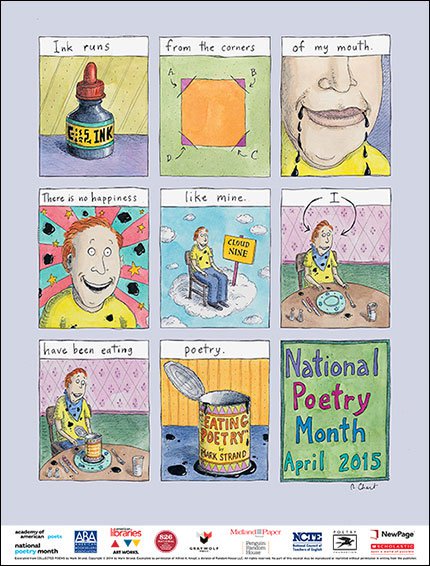
Also well known is "Eating Poetry" by Mark Strand, which appeared on this year's National Poetry Month poster and begins:
Ink runs from the corners of my mouth. There is no happiness like mine. I have been eating poetry...
But what I am more interested in for this month's prompt is what Galway Kinnell does in his poem "Blackberry Eating."
Maybe the Galway Hospital triggered the Kinnell connection, but in his poem we have him first being quite literal in his eating -
I love to go out in late September among the fat, overripe, icy, black blackberries to eat blackberries for breakfast, the stalks very prickly, a penalty they earn for knowing the black art of blackberry-making;
- and then something else happens. The blackberries, with their "black art" become words, if not poems.
and as I stand among them lifting the stalks to my mouth, the ripest berries fall almost unbidden to my tongue, as words sometimes do, certain peculiar words like strengths or squinched, many-lettered, one-syllabled lumps, which I squeeze, squinch open, and splurge well in the silent, startled, icy, black language of blackberry-eating in late September.
The prompt this month is poetry as food - poems that explore how we consume poetry, what it gives us, and may or may not contain references to actual foods.
With holidays and such at year's end, I'm sure you will have more than enough foods prompting you.
The submission deadline for this prompt is January 10, 2016.
For National Poetry Month last year, poets who serve on the Academy of American Poets Board of Chancellors participated in Poet-to-Poet, a multimedia educational project. Through videos, they invited young people in grades three to twelve to write poems in response to those shared by the poets. Here is one of those poems.
After reading the poem, Jane talks in the video about the poem and tells us it is an ode. �Ode� is from the Greek aeidein, meaning to sing or chant. It is an old form of lyric poetry which would have originally been accompanied by music and dance.
The Romantic poets used it as a way to formally address an event, a person, or a thing not present. There are three typical types of odes: the Pindaric, Horatian, and Irregular. You can check into the more formal aspects of each, but we're being more general in our approach this month.
The Horatian ode (named for the Roman poet Horace) is more contemplative, less formal, less ceremonious, and less theatrical. Look at the Allen Tate poem �Ode to the Confederate Dead.
The Irregular ode is just that. �Ode on a Grecian Urn� by John Keats was actually written based on his experiments with the sonnet.
For this month, we ask you to write an ode that focuses on the body. Jane Hirshfield's poem opens with her direct address to the skeleton.
My skeleton, you who once ached with your own growing larger
She follows chronologically, following the skeleton as it ages.
each year imperceptibly smaller, lighter, absorbed by your own concentration.
Generally, the aging of the body is not a kind thing.
Angular wristbone's arthritis, cracked harp of ribcage
And finally, she concludes with this beautiful image of its life work.
You who held me all my life inside your hands as a new mother holds her own unblanketed child, not thinking at all.
Our November prompt is an ode about a part of the body. I suppose the skeleton is a part of the body, although it is made up of many smaller parts. That is true of the ear, the hand and the brain, so you might want to choose a specific part. You might choose the nose, a breast, the mouth, lips, tongue or a thumb. So many options. You don't need to get down to an anatomical level (although that might be interesting) and you could easily be like those Romantic poets in your approach.
One ode I heard read aloud by the poet several times is "Homage to My Hips" by Lucille Clifton. It is a short poem that probably would not count as an ode by Horatio's standards, but I'm fine with it as an ode.
these hips are big hips. they need space to move around in. they don't fit into little petty places. these hips are free hips. they don't like to be held back. these hips have never been enslaved, they go where they want to go they do what they want to do. these hips are mighty hips. these hips are magic hips. i have known them to put a spell on a man and spin him like a top
Everyone seems concerned with losing weight, watching calories and avoiding heavy foods these days. It seems natural that we might want our verse a bit lighter too.
The title says it pretty succinctly. Some light verse is lyrical, some vulgar, some pathetic.
Keillor says that when he was in high school an English teacher tried to interest him in "Mr. Frost's guy who stopped in the woods to see snow fall and Mr. Eliot's guy who was not sure whether he should eat a peach" but that didn't work. It was "like serving bran flakes to someone who'd eaten buttermilk pancakes slathered with maple syrup."
Maybe you have read Lewis Carroll, Edward Lear or Ogden Nash or even W.S. Gilbert or, as Keillor has it "the great Anon." Light verse may be an acquired taste, but no one seems to consider it gourmet dining. It's more like acquiring a taste for cotton candy.
There are many notable poets in this genre and many "regular" poets who dabbled in light verse. Even serious Mr. Eliot wrote that book of cat poems that went on to be a long-running Broadway play.
Old Possum's Book of Practical Cats ("Old Possum" was Ezra Pound's nickname for him) was Tom's shot at light verse. After Eliot's death, the book was adapted as the basis of the musical Cats by Andrew Lloyd Webber.
Here is one of Garrison Keillor's poems that I like in this genre:
Cicadas The seventeen-year cicada crawls out of the ground And looks around from a wall or a low-hanging limb� He looks for her and she discovers him. Courtship does not extend for months. Their only job is to have sex once. No long interlude of pleasant reminiscing about days gone by. Just buzz and whir and thank you sir and then you die. Cicada love does not involve poetry or song. Was it good for you? Thanks. So long.
What is this light poetry, or light verse? I would say that it attempts to be humorous (not the same thing as "funny" as anyone who has ever read an anthology of humor). They are usually brief. They can be on a frivolous or serious subject. You'll want to feature some word play, including puns, adventurous rhyme and alliteration.
There are plenty of anthologies of light verse and the journal Lightis a source of new poems. I was delighted to see that one of my online friends, Toby Speed, has the "Poem of the Week" on their site. Hers is a good, terse example of all the "rules" I listed above. Of course, poets of light verse laugh and make puns from rules.
How to Use a Lemon
Squeeze some into tea. Frizzle off the zest. Add it to piccata and pith away the rest.
~ Toby Speed
This prompt is open to submissions until the deadline: October 18, 2015
Years ago, I was interested to see a feature in The Saturday Review each issue that was called "Writer's Desk." The idea was simple. It showed a writer's actual desk and explained a bit about how they worked there. I always thought that I might gain some insight into writing or writers by knowing about the how and where of their writing. It is a questionable theory, but when I visit a writer's home I am still interested in seeing their writing space.
I was interested to see that a poem by Juan Felipe Herrera, who was recently named Poet Laureate of the United States, was used during National Poetry Month as a writing prompt about home.
Juan Felipe Herrera reads �Five Directions to My House� as part of National Poetry Month 2014. https://youtu.be/8UPjEcaCG5E
Five Directions to My House 1. Go back to the grain yellow hills where the broken speak of elegance 2. Walk up to the canvas door, the short bed stretched against the clouds 3. Beneath the earth, an ant writes with the grace of a governor 4. Blow, blow Red Tail Hawk, your hidden sleeve�your desert secrets 5. You are there, almost, without a name, without a body, go now 6. I said five, said five like a guitar says six.
Turn around go to the end of the long bridge Into the wave of clouds under the colorless arch Under the heat of the center core. Over the peregrine falcon flying fast as the race car Out of the endless underwater cave Around the wheel of fortune, around, around, around the wheel. I said six, said six like a rainbow says seven.
One, the mountain cradles the rising sun as it leaves a warm pink collection of colors in the air. Bright, brutal sunlight turns the sky on like an electrical switch and the sky becomes alive.
Two, the staccato of a wood pecker tapping on my roof in the morning stirs me awake.
Three, an endless stretch of rocks and dirt, harsh to the eyes, a barren desolate land.
Four, a dead bunny carcass lies on the newly paved road, it ran towards the wheels of a car. Now, it�s left behind a sore sight for all except hungry lone scavengers.
Five, time, time slips through the fingers like yellow grains of sand left behind on a beach. Even time moves slowly in this eternal home.
Your writing prompt is to write a poem that gives directions (in any format) to your house or any particular house - including the home of a poet - take a look at my earlier post about writer's homes.
We love our pets. Writers love their pets, and they often write about them. I see more and more books about dogs and cats, and that includes poetry.
I recently went to a reading with Billy Collins who has a good number of dog poems. In two of those, he introduces us to dogs "whom have taken the command 'speak' quite literally."
One of those which has the dog contemplating his relationship to his owner, is titled "A Dog on His Master" - a title that makes me recall an old advertising slogan from the RCA Victor company used for early phonographs.
A DOG ON HIS MASTER As young as I look, I am growing older faster than he, seven to one is the ratio they tend to say. Whatever the number, I will pass him one day and take the lead the way I do on our walks in the woods. And if this ever manages to cross his mind, it would be the sweetest shadow I have ever cast on snow or grass.
In Dog Years: A Memoir, poet Mark Doty decides to adopt a dog as a companion for his dying partner. Beau is a large, malnourished golden retriever in need of love. He joins Arden, their black retriever. These two companions accompany them on the sad journey and teach lessons about love and loss.
I loved Doty's poem (or is it Beau's poem?) "Golden Retrievals" the first time I heard him read it. Like many of Collins' poems it hits you as light and funny, especially in his reading of it. But, also like Collin's poems, there is something more serious going on in the poem.
The dog starts off with his joy in his dog world, rejecting the people world of:
Fetch? Balls and sticks capture my attention seconds at a time. Catch? I don�t think so.
He is far more interested in:
Bunny, tumbling leaf, a squirrel who�s�oh joy�actually scared. Sniff the wind, then I�m off again: muck, pond, ditch, residue of any thrillingly dead thing.
But his poor owner is:
Either you�re sunk in the past, half our walk, thinking of what you never can bring back, or else you�re off in some fog concerning �tomorrow, is that what you call it?
The dog knows that his work here is part Zen master and part physicist trying:
to unsnare time�s warp (and woof!), retrieving, my haze-headed friend, you.
Mark Doty's �Golden Retrievals� (from Sweet Machine: Poems) is this month's model poem for our writing prompt. And who would have guessed that Beau was a formalist, writing a kind of sonnet.
Your assignment this month is a poem that comes from the mind, heart or mouth of a pet or animal. Let your dog or cat at the keyboard or have them channel the poem to you in that sixth or seventh sense that we know they possess.
Submission deadline: June 30, 2015
I also recommend that you give a look and listen (below) to Billy Collins reading "A Dog on His Master" and one of my favorites, "The Revenant." The revenant (one who has returned, especially from the dead) dog speaking the latter poem is not in love with his master - the person who put him "to sleep" - in fact, "I never liked you - not one bit."
Like Beau, Collins' former pet also loves those outdoor smells encountered on walks, "but only because it meant I was about / to smell things you had never touched."
This dog's only somewhat kind remark is to confirm something about the afterlife that the poet had hopefully assumed: "that everyone here can read and write, the dogs in poetry, the cats and the others in prose."
It is National Poetry Month 2015 in America. The Academy of American Poets has many special features on its website for this month. One is called "Dear Poet." It is a multimedia education project that invites young people in grades five through twelve to write letters in response to poems written and read by some of the award-winning poets who serve on their Board of Chancellors.
Poets Online asks you this month to join the students. You can read and watch a group of poets reading and discussing their poems. The students are being asked to write letters to the poets to express their thoughts, ideas, or ask any questions they may have about the poems. I wonder why they didn't ask students to write poems to the poets - which is what we we will do.
Epistles, or epistolary poems, comes from the Latin �epistula� for �letter," are poems that read as letters. As poems of direct address, they can be intimate and colloquial or formal and measured.
On our main site, the prompt includes two of the poems and poets from Dear Poets. One is Naomi Shihab Nye's "How Do I Know When A Poem Is Finished?" which itself is addressed to someone - perhaps a student who has asked the poet that question, though all poets ask that question to themselves.
The second example and video is for Edward Hirsch's poem "Cotton Candy" which looks back to the candy and a grandfather.
What would you write to Nye or Hirsch about their poems?
Our prompt is much wider. You can choose any poem on the Academy site or any poem at all. The only requirement is that you address the poet by name and that you include the title of the poem you are responding to in the poem.
Your poem might be titled "Dear Mr. Hirsch" or Dear Elizabeth" for a poem to Elizabeth Bishop, whose own epistle "Letter to N.Y." begins:
In your next letter I wish you�d say where you are going and what you are doing; how are the plays, and after the plays what other pleasures you�re pursuing:
taking cabs in the middle of the night, driving as if to save your soul where the road goes round and round the park and the meter glares like a moral owl
I might write to W. B. Yeats during this Easter week 2015 about his poem "Easter 1916" to let him know that this year:
I am sitting at the start of day looking out the window at my desk at a sky gray above twenty-first century homes
that I have passed on my way, like you, nodding and saying polite meaningless words...
If you are in a part of the world covered with snow, you may identify in that way with this month's model poem: "Shoveling Snow With Buddha" by Billy Collins. Our prompt for February is writing about someone who is well known but in your poem "out of place."
I like that in Collins' poem the Buddha is out of place for several reasons. First, he is doing something and we are used to seeing him seated and meditative. We also usually find him in a nice temperate setting, not in the snow. Of course, he is also out of place because he is out of time, dropped into our present from his past.
Besides the idea that he is helping shovel snow, he is also quite interested in hot chocolate and playing cards after the shoveling - two rewards for his work, not unlike a child's rewards for helping clear the snow.
He is more Buddha-like in his mindfulness of the work.
He has thrown himself into shoveling snow as if it were the purpose of existence, as if the sign of a perfect life were a clear driveway
Collins is no real life Buddhist, though he is mindful, but the poem touches on several ideas in Buddhism. Like most of Collins' poems, the light, perhaps funny, surface of the poem is a way to slide into more serious points. In this poem, I am reminded about how often we forget that the journey is the destination, and how often we want to be anywhere but in the now.
This prompt asks you to place a well-known person (living or dead, real or fictional) somewhere out of place. There is the suggestion of something absurd in this, although Emily Dickinson at Starbucks is not as odd as if you made her a Victoria's Secret runway model, so the choice is yours when it comes to that aspect of the prompt.
Terrance Hayes invented a poetry form he calls the Golden Shovel. You take a line (or lines) from a poem you admire, and use each word in the line (or lines) as an end word in your poem while maintaining the order. So, if you choose a line with six words, your poem would be six lines long.
This borrowing method is not without precedent in poetry. One similar form is quite ancient: the cento, in which you make a poem entirely from other poets' lines. Another form makes a new poem by removing lines from an existing poem - that is known as an erasure.
For my own first Golden Shovel attempt, I wrote a poem for my daily writing practice last year. I chose a poem by Gary Snyder called "Changing Diapers" and used his line "you and me and Geronimo." I wrote it in the ronka form that all my daily poems for 2014 used.
Geronimo [after Gary Snyder]
After the reading, talking briefly to you and recalling another time � when I, Steve and you shared coffee conversation � you remembered me. A wonderful lie. We are men, and we jump like paratroopers and shout Geronimo.
My poem came out of a brief encounter with Snyder recently when he read at the Dodge Poetry Festival in New Jersey. It also recalls a longer conversation we had at another Dodge Festival more than 20 years ago.
In what I believe must be the first Golden Shovel poem, Terrance Hayes used a Gwendolyn Brooks poem. He started with Brooks' often-anthologized poem, "We Real Cool." His poem is called "The Golden Shovel.".
"The rules" for this new form are:
Take a line(s) from a favorite poem
Use each word in the line (or lines) as an end word in your poem and
Keep the end words in the order they appeared originally. That means that you could read the stanza at the right edge like an acrostic.
Give credit to the original poet (it can be in the title, an epigram or within the poem) and for our prompt also include a note a reference to the poem, though it doesn't have to be part of the poem itself. It would be great if you could include a link to the original poem online so that readers could see your inspiration.
The new poem does not have to be about the same subject as the original poem, but it can be related.
We know how poets love to play by the rules. Mr. Hayes pushes a bit on his own rules by using more than a line and and using every word from the Brooks poem. Twice. Setting the bar high. In his collection, Lighthead, he also has a poem using Elizabeth Alexander's poem, �Ladders� (for his "Last Train to Africa") and borrows lyrics from songs by Marvin Gaye and Louis Armstrong for others.
___________________________________
Terrance Hayes' poem �The Golden Shovel� is from Lighthead (2010, Penguin) which won the National Book Award.
Extra Credit: Think you know why Hayes called his poem and form "The Golden Shovel?" Tell us your answer in a comment on this post.


 I have always found that being out in nature feels like healing to me. This feeling is captured simply in "




 about his adopted son who died at age 22 in 2011.
 .
.
 's poem opens with her direct address to the skeleton.
 . It is a short poem that probably would not count as an ode by Horatio's standards, but I'm fine with it as an ode.


 )
)
 , poet Mark Doty decides to adopt a dog as a companion for his dying partner. Beau is a large, malnourished golden retriever in need of love. He joins Arden, their black retriever. These two companions accompany them on the sad journey and teach lessons about love and loss.
 ) is this month's model poem for our writing prompt. And who would have guessed that Beau was a formalist, writing a kind of sonnet.
 , written in the voice of a dog.


 (2010, Penguin) which won the National Book Award.