Empty girl I was, so far inside, grass didn't know me
It was something unbending, only light seemed to touch
But so long as I could smell the sea, so long as salt
I had extrications, music, that fire, phase & beat
And all around the world went off, banners & avenues, cruelties
Now it's come one, come all, a kind of sassy hoedown
The grass is going, it cracks & withers sadly, almost infinitely
But
Featured Post
Your Life Is a Poem
In the new episode of ON BEING, " Your Life Is a Poem ," poet Naomi Shihab Nye talks about growing up in Ferguson, Missouri and o...

Monday, August 12, 2013

Monday, August 5, 2013
Where, by Paula Morris
Where are
you from, I ask the waiter.
He is from
Brazil, Poland, Florence.
Sometimes
he is from Mexico, and I
say: so is
my nephew�s fianc�e.
In Auckland
the taxi driver who lives in
Henderson
is from Afghanistan. There are
forty of
them there, he says. They love it, but
they have to make their own bread.
In New York
the taxi driver is from Pakistan.
He asks me
where I�m from, and
you from, I ask the waiter.
He is from
Brazil, Poland, Florence.
Sometimes
he is from Mexico, and I
say: so is
my nephew�s fianc�e.
In Auckland
the taxi driver who lives in
Henderson
is from Afghanistan. There are
forty of
them there, he says. They love it, but
they have to make their own bread.
In New York
the taxi driver is from Pakistan.
He asks me
where I�m from, and
Thursday, August 1, 2013
Prompt: Alliteration, Masturbation and Other Literary Terms
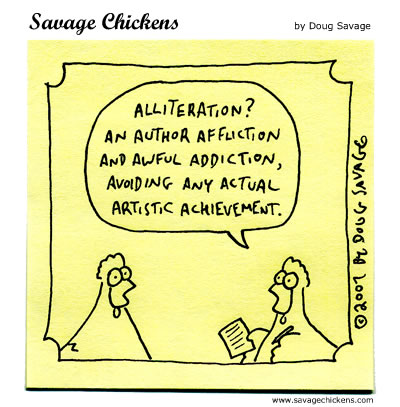
We all were taught literary terms in school, especially during some poetry unit. Simile, metaphor, personification and many others were supposed to be the common vocabulary and grammar we used to dissect the poems.
This month's model poem for our prompt is one that is titled with a literary term - alliteration. The poem itself is no ars poetica though.
Alliteration
by Paul Hostovsky
I whacked off in these woods once.
But that was a long time ago when
everything rhymed a little with
the trees all facing upward and the sky
was full of itself and no one
was around. And everything smelled good.
I smelled good myself. A sweaty,
muddy, musky, burning smell of
autumn or late summer or very early
spring was in the air, and I was so
excited to be so young and existential
and solipsistic, that I peeled off my shirt
and pants and underpants, and stood there
erect and steeply rocking under a sycamore,
my peeled bark in a little pile at my feet,
my head tossing in the wind, my mouth
opening, wider, wider, as if trying
to pronounce all the vowels at the same time
and failing deliciously, and sinking down
to the ground, totally spent and spluttering
a few choice consonants like kisses meant
for the pursed lips of the wind.
We know that alliteration is the repetition of the initial sounds (usually consonants) of stressed syllables in neighboring words. Usually it occurs at word beginnings, as in this line from Shelley's "The Cloud": I bear light shade for the leaves when laid.
The poem has alliteration, but do you see a connection from the term to the poem's subject? Repetition? The "few choice consonants" of spluttered sound? How intentional was it in this somewhat naughty-boy poem that has several puns that another name for alliteration is head rhyme?
For our August prompt, select a literary term as your title and starting point. Besides the common terms, there are plenty of lesser known ones (like half rhyme). And a term like "meter" has many sub-topics to offer. Pentameter and caesura suggest things outside of poetry to me. What would a poem titled "Free Verse" or "Masculine Verse" or "Feminine Verse" address?
To avoid preconceived notions, perhaps you should just browse a list of literary terms for poetry and find one that gets your interest.

 (2012), A Little in Love a Lot (2011), Dear Truth (2009), and Bending the Notes (2008). His poems have won a Pushcart Prize, two Best of the Net awards, numerous chapbook contests, and have been featured on Poetry Daily, Verse Daily, and The Writer's Almanac. He works in Boston as a sign language interpreter at the Massachusetts Commission for the Deaf
 "Alliteration" is from his forthcoming book Naming Names which can be pre-ordered now online.
Paul is online at www.paulhostovsky.com
Monday, July 29, 2013
Surface, by Peter Munro
Swept among seas that walk downwind,
beaks and feathers wheel to hook and pick.
Skimming low, fulmars heel and spin
speed. Their twines knot the world to its quick.
I learn to listen with my skin.
Gusts kiss me, whispering their cold.
Caressed in tempos that whitecaps kick,
rust scours my vessel, fills her holds.
She presses into a surface nicked
by birds feeding where salt unfolds.
Fulmars
beaks and feathers wheel to hook and pick.
Skimming low, fulmars heel and spin
speed. Their twines knot the world to its quick.
I learn to listen with my skin.
Gusts kiss me, whispering their cold.
Caressed in tempos that whitecaps kick,
rust scours my vessel, fills her holds.
She presses into a surface nicked
by birds feeding where salt unfolds.
Fulmars
Monday, July 22, 2013
Tika by Saradha Koirala
Goodbye takes the form of a
blessing.
My family press tika on our
foreheads
rupees into my palm.
Mountain-high through time
and air
the red paint dries, the
rice grains fall
leaving a trail that could
surely lead us home.
But sometimes you can't tell
what you've seen
until you close your eyes
and the imprint reveals
an inverted world of
darkened brights
and a pale sky
a halo
Monday, July 15, 2013
A Garage by Robert Gray
In one of the side streets
of a small hot town
off the highway
we saw the garage,
its white boards peeling
among fronds and palings.
The sun had cut a blaze
off the day. The petrol pump
was from the sixties�
of human scale
and humanoid appearance
it had a presence,
seemed the attendant
of our adventures on the road,
the doorman of our chances.
We pulled in, for nostalgia,
onto
Tuesday, July 9, 2013
Prompt: First (Poetic) Love
Who is the first poet you fell in love with? In this video from The Poetry Foundation, Edward Hirsch, Evie Shockley, Jean Valentine, Juan Felipe Herrera, Katy Lederer, Marilyn Hacker, Pierre Joris and Rachel Levitsky talk about first poetry loves.
Several of the poets ask the interviewer if the question is meant literally or figuratively, or if the answer can be a poem rather than the poet. This inspired me use that first love of poetry as our prompt and inspiration.
Who is the poet that was your first love? This might be the love of a poem, but it might be a crush on the poet, either by way of a poem or just a photo on a book jacket or an encounter at a reading.
 |
| Emily, as she appears on "her" Twitter page |
I had an adolescent crush on plain old Emily Dickinson because I felt sorry for her and imagined that if I had been there in Amherst that I might have been friends with her. I would have gotten her outside into nature and maybe we would have even dated.I also had a crush on glamorous Marilyn Monroe at that time because I also wanted to save her from the world.
In �Taking Off Emily Dickinson�s Clothes,� Billy Collins takes that idea to a playful extreme. His poem is an extended metaphor for reading a Dickinson poem. The undressing is also the uncovering of the poems. FOr example, taking off her "tippet made of tulle� is like opening her book.
First, her tippet made of tulle,
easily lifted off her shoulders and laid
on the back of a wooden chair.
And her bonnet,
the bow undone with a light forward pull.
Then the long white dress, a more
complicated matter with mother-of-pearl
buttons down the back,
so tiny and numerous that it takes forever
before my hands can part the fabric,
like a swimmer�s dividing water,
and slip inside.
Emily's simple poems are "a more complicated matter" when you actually read them. They are not so easy.
Later, I wrote in a notebook
it was like riding a swan into the night,
but, of course, I cannot tell you everything -
the way she closed her eyes to the orchard,
how her hair tumbled free of its pins,
how there were sudden dashes
whenever we spoke.
Emily's habit was to wear a white dress, although she rarely left her family home in Amherst. She was a recluse for the latter part of her life, hiding behind the door when there were visitors. It is assumed that she died a virgin. You can hear Billy Collins read this poem and some of Emily's poetry online and Collins says that "There are many speculations about her...Was she lesbian? Was she celibate? Did she have an affair?" All of that speculation inspired him to write the poem in which he wanted, in a playful way, to put the guessing to rest by undressing her and having sex.
 |
| Naomi Shihab Nye |
In another video, Naomi Shihab Nye talks about how poetry inspires us. She says, "I've carried, for perhaps 30 years, a very tattered piece of notebook paper that says: Philip Levine has described the muse as 'being the portion of the self that largely lives asleep. Being inspired is really being totally alive.' He says that such a state feels a 'little odd' and also 'delicious.' " She also carries with her William Stafford's poem, "The Sky."
Despite my Emily and Naomi crushes, the poem I carry in my wallet is "When You Are Old" by William Butler Yeats
 . That was one I fell in love with in high school and that I memorized and that reads even better to me as I grow old and gray and full of sleep myself.
For this month's writing prompt, we write about First (Poetic) Love. This can mean the first poem you recall loving or the first poet you loved (in any sense of the word).
Submission Deadline: Wednesday, July 31st
Subscribe to:
Posts (Atom)