The Poetry Foundation has collected poems that explore the African-American experience to celebrate Black History Month.
http://www.poetryfoundation.org/black-history-month/
Featured Post
Your Life Is a Poem
In the new episode of ON BEING, " Your Life Is a Poem ," poet Naomi Shihab Nye talks about growing up in Ferguson, Missouri and o...

Sunday, February 3, 2013

Saturday, February 2, 2013
EXIT 13

Tom Plante started the magazine which he named after the Elizabeth exit off the New Jersey Turnpike where Tom once lived. It is a very much a labor of love and one-man operation by Tom who has edited and published the magazine since 1988. The annual issues also feature photos of exit 13 road signs contributed by correspondents. Plante sends a copy of the magazine to each photographer whose work is published.

Tom Plante has personally been writing poetry for over forty-five years. �Poetry is necessary,� he says. �Poems are road maps for the soul; the GPS of a higher plane."
Before he moved to the New Jersey, Plante lived in the San Francisco Bay area of California. There, he worked with a friend to produce a small poetry magazine called Berkeley Works. Plante�s work in California gave him the inspiration to start his own literary magazine on the east coast.
The journeys of all the contributors gives us poems with a geographic point of view - a supermarket at the Jersey Shore, the Philadelphia Flower Show, souvenir shopping in Gallup, the Witches Market in La Paz, and buying a final round in Belgooly, Ireland.
There will be an EXIT 13 25th Anniversary Issue reading event October 15, 2013 as part of the Carriage House Poetry Series in Fanwood, NJ.
Friday, February 1, 2013
A Poem for Candlemas Eve
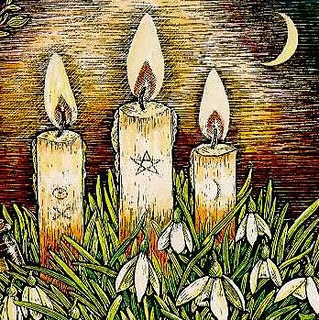
Superstitions of an earlier time said that leaving traces of berries, holly and other decorations would bring death among the congregation before another year is out. Another belief was that anyone who hears funeral bells tolling on Candlemas will soon hear of the death of a close friend or relative.
Hopefully, your neighbors have taken down their outdoor Christmas decorations by now. If not, perhaps you should share the old beliefs with them.
Read more about Candlemas traditions
CEREMONIES FOR CANDLEMAS EVE
by Robert Herrick
Down with the rosemary and bays,
Down with the mistletoe ;
Instead of holly, now up-raise
The greener box (for show).
The holly hitherto did sway ;
Let box now domineer
Until the dancing Easter day,
Or Easter's eve appear.
Then youthful box which now hath grace
Your houses to renew ;
Grown old, surrender must his place
Unto the crisped yew.
When yew is out, then birch comes in,
And many flowers beside ;
Both of a fresh and fragrant kin
To honour Whitsuntide.
Green rushes, then, and sweetest bents,
With cooler oaken boughs,
Come in for comely ornaments
To re-adorn the house.
Thus times do shift ; each thing his turn does hold ;
New things succeed, as former things grow old.
for more poems by Herrick, see http://www.luminarium.org/sevenlit/herrick/herribib.htm
Thursday, January 31, 2013
Why Write?
I wrote on another site about the idea of devoting 20% of your time to something outside you regular "work.". It's a philosophy followed at Google and other companies. It could be a workplace habit, but it could also be something to follow in your non-working life.
 My 20% seems to be writing, whether that is poetry, journaling, research or essays online and in print. If I devoted a fifth of my free time to one writing task - like a poetry manuscript - I might be a more successful writer. But, like most of my distracted life, I split that percentage into writing different things in different places.
There are five blogs that I write on regularly, including this one, and three others that I contribute posts to occasionally. I don't get paid to do that writing. But I wouldn't say that I do it for "fun" either. Plus, I do the regular Poets Online website which archives all of the prompts and poems that have been submitted since 1998. It's hard to explain to most people (especially to my wife) exactly why I do it.
I was reading another blogger, Maria Popover, who writes the Brainpickings.org blog. She has a "writing tip jar" on her site which says that "Brain Pickings remains ad-free and takes 450+ hours a month to curate and edit, between the site, the email newsletter, and Twitter. If you find any joy and value in it, please consider becoming a Member and supporting with a recurring monthly donation of your choosing, between a cup of coffee and a fancy dinner."
That is like the public television and radio model. You listen, so you should pay something. Luckily, enough do pay, but the paying listeners are a small percentage of the listeners.
 Most bloggers don't have a pay model or a contributor model using PayPal or some other subscription. Some blogs have ads. I do that. Amazon ads are one of the most popular vendors. I will put those links here for books I am discussing. But from all five of my blogs, I am surprised when in a three-month quarter they generate enough sales to have Amazon make a minimal payment which is only $10. So, I'm not getting rich by writing online.
I had always hoped that the ads would cover the cost of some domain names and hosting that I pay every year. You pay to own a domain name like poetsonline.org. Some sites, like this one on Blogger, are hosted for free. Others require a yearly fee.
There are people who blog and make a living at it. There are people who are poets and make a living at it. But not many. Every poet I know does something besides write and publish poetry to earn a living. Teaching is the most common job, whether it is in a school or in workshops.
So, why do we write our blogs and poems? I haven't come up with a definitive answer, but I have some ideas for myself.
I do hope it gets my name out there as a writer and that it leads to further opportunities and maybe some income. So, it is advertising for myself.
I like telling people things that I think will be helpful. I have been a teacher since 1975. It paid the bills, but teachers know that part of the reward is knowing that you are doing something good for your students and, in some small way, for the world.
I also like the occasional connections that come from writing online. That means anything from the person who "favorites" a post, makes a positive comment, emails a note, links to your writing. I have even had a few people find me online and ask me to do a workshop or give a presentation at a conference.
But all that perhaps isn't enough to "justify" the time spent doing this.
What are the other things that keeps us doing that 20% that we don't get paid to do? Whether it is poetry or volunteer work, why do you do it? Comment?
 My 20% seems to be writing, whether that is poetry, journaling, research or essays online and in print. If I devoted a fifth of my free time to one writing task - like a poetry manuscript - I might be a more successful writer. But, like most of my distracted life, I split that percentage into writing different things in different places.
There are five blogs that I write on regularly, including this one, and three others that I contribute posts to occasionally. I don't get paid to do that writing. But I wouldn't say that I do it for "fun" either. Plus, I do the regular Poets Online website which archives all of the prompts and poems that have been submitted since 1998. It's hard to explain to most people (especially to my wife) exactly why I do it.
I was reading another blogger, Maria Popover, who writes the Brainpickings.org blog. She has a "writing tip jar" on her site which says that "Brain Pickings remains ad-free and takes 450+ hours a month to curate and edit, between the site, the email newsletter, and Twitter. If you find any joy and value in it, please consider becoming a Member and supporting with a recurring monthly donation of your choosing, between a cup of coffee and a fancy dinner."
That is like the public television and radio model. You listen, so you should pay something. Luckily, enough do pay, but the paying listeners are a small percentage of the listeners.
Most bloggers don't have a pay model or a contributor model using PayPal or some other subscription. Some blogs have ads. I do that. Amazon ads are one of the most popular vendors. I will put those links here for books I am discussing. But from all five of my blogs, I am surprised when in a three-month quarter they generate enough sales to have Amazon make a minimal payment which is only $10. So, I'm not getting rich by writing online.I had always hoped that the ads would cover the cost of some domain names and hosting that I pay every year. You pay to own a domain name like poetsonline.org. Some sites, like this one on Blogger, are hosted for free. Others require a yearly fee.
There are people who blog and make a living at it. There are people who are poets and make a living at it. But not many. Every poet I know does something besides write and publish poetry to earn a living. Teaching is the most common job, whether it is in a school or in workshops.
So, why do we write our blogs and poems? I haven't come up with a definitive answer, but I have some ideas for myself.
I do hope it gets my name out there as a writer and that it leads to further opportunities and maybe some income. So, it is advertising for myself.
I like telling people things that I think will be helpful. I have been a teacher since 1975. It paid the bills, but teachers know that part of the reward is knowing that you are doing something good for your students and, in some small way, for the world.
I also like the occasional connections that come from writing online. That means anything from the person who "favorites" a post, makes a positive comment, emails a note, links to your writing. I have even had a few people find me online and ask me to do a workshop or give a presentation at a conference.
But all that perhaps isn't enough to "justify" the time spent doing this.
What are the other things that keeps us doing that 20% that we don't get paid to do? Whether it is poetry or volunteer work, why do you do it? Comment?
Wednesday, January 30, 2013
Robert Frost: Darkness or Light?
From The New Yorker blog:
Joshua Rothman looks at the poet�s two sides: http://nyr.kr/VSHmr5
Yesterday was the fiftieth anniversary of Robert Frost�s death.�It�s hard to imagine the author of �Stopping By Woods on a Snowy Evening��the watcher of trees and grass, of frozen lakes and forested darkness�pinning up political posters in a crowded San Francisco bar. But, while the personality that comes through in Frost�s poems was a genuine one, it was also edited...
Photograph: Library of Congress.

Joshua Rothman looks at the poet�s two sides: http://nyr.kr/VSHmr5
Monday, January 28, 2013
Poetry By Heart

United Kingdom's Department for Education is funding a nationwide poetry-reciting contest that asks kids to spend some time lingering over a poem. Long enough to learn it by heart.
The program is called "Poetry By Heart" and it is similar to the American "Poetry Out Loud" program.
At a county level, students memorize two poems from a list of 130and recite the poems by heart in a series of competitions. Their website has a nice selection of poems that are well known and not so well known - especially for American audiences.
The interview I heard said that the intent was to learn them "by heart, not by rote." They define that as meaning "that if you learn by heart it means you take the poem right into yourself, it becomes part of you. And it remains with you, probably for the rest of your life."
A difficult distinction to impress upon a young person. But hurrah for the trying.
Interview: Jean Sprackland, "Poetry By Heart" Contest via NPR
ALWAYS ALMOST, NEVER QUITE by David Howard
at home ?in the interpreted world
-
Rainer Maria Rilke, Duino Elegies I
1
The tree on the slope is contingent upon
your voice.
I hear nothing so the tree won�t bend �
I need that tree to bend.
The horizon does not want poetry to keep
going.
Intention? No star meant to be admired and yet�
Praise is impossible without doubt, ask a
teenager.
The
Subscribe to:
Posts (Atom)